





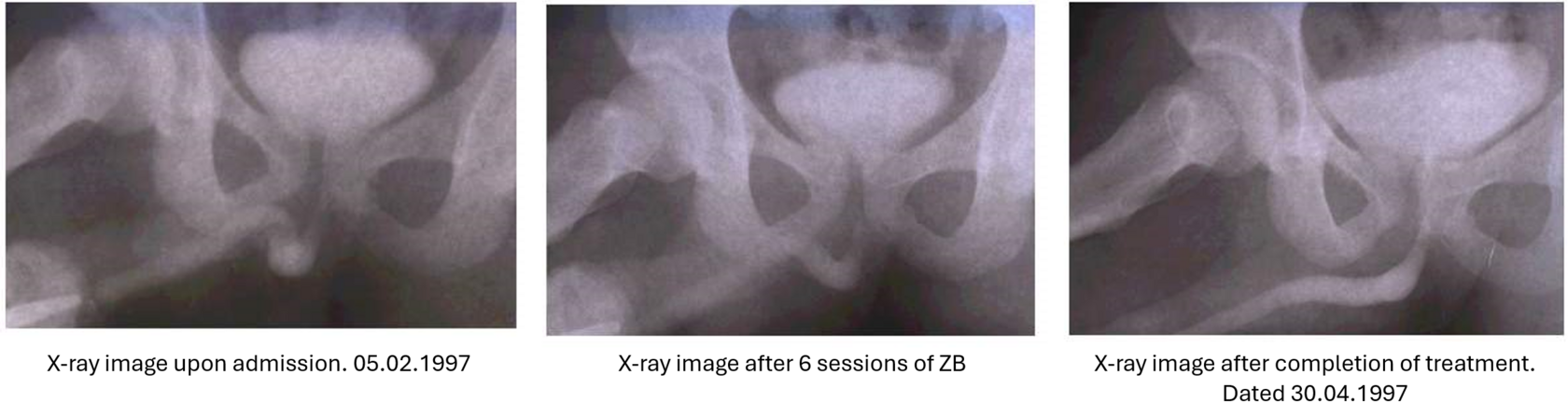
A 17-year-old male patient, in 1996, was involved in a car accident and suffered multiple injuries (fracture of the ischial bone, fractures of the tibia, and two fractures of the femur). He spent a long time in the trauma unit where he underwent two surgeries for the fractures. Post-operatively, he noted an inability to urinate independently, requiring catheterization. He was discharged with recommendations for further surgical treatment in urology departments, where urethral reconstruction was recommended, or, if surgery was refused, lifelong weekly urethral dilation. In February 1997, he sought our help, refusing surgical treatment. An urethrocystography performed on 05.02.1997 showed a large bend in the prostatic part of the urethra and a fracture of the ischial bone in two places, with displacement in the lower part. He was troubled by difficult urination with a weak, bifurcated stream. He underwent urethral dilation every 5 days.
After the 1st session of ZB + KL (local, 10 minutes), the patient felt increased warmth during urination.
After the 3rd session, the urine stream became stronger, the color of the urine changed, and there was a presence of blood in the stream.
Dilation was performed every 7 days.
After the 6th session of ZB, dilation was noted to be easier. Before treatment, there was a step-like obstruction (at least 3-4 steps), now only one step remained. Urgency to urinate appeared, with a full urine stream.
After the 9th-10th session of ZB, the dilator passed freely, with slight resistance at the end. Following this, he was sent for a control urethrocystogram, which showed a significant smoothing of the "bend" at the transition from the prostatic to the membranous urethra. Dilation was performed every 18 days. Another course of ZB - 10 sessions, KL - 6 sessions, and KB - 6 sessions on the pelvic bones in the fracture area for 1-2 minutes each was completed, after which dilation was discontinued. The urine stream became full, and urination was free. The control x-ray on 30.04.1997 showed that the patient had fully recovered due to infrared therapy.
Clinical observation materials:
Radiograph: Combined injury and fracture healing dynamics