





Technology That Works with Moisture Rather Than Merely Heating Raw Material
In traditional convective drying, the primary task is accomplished by heating air and transferring heat to the material surface. The IR approach utilizes a different physical mechanism: the radiation spectrum is tailored so that a substantial portion of the energy is directly absorbed by water molecules. This allows targeted action upon internal moisture while dynamically controlling process intensity.
The core distinction of the proposed system is functional ceramics. It is viewed not as a standard heating element, but as a spectral-temporal converter generating pulsed infrared radiation. The ceramic layer is deposited onto quartz tubes containing nichrome heating coils, while raw cotton or seeds are conveyed on a mesh tray for double-sided treatment.
Main Advantage — Energy Efficiency
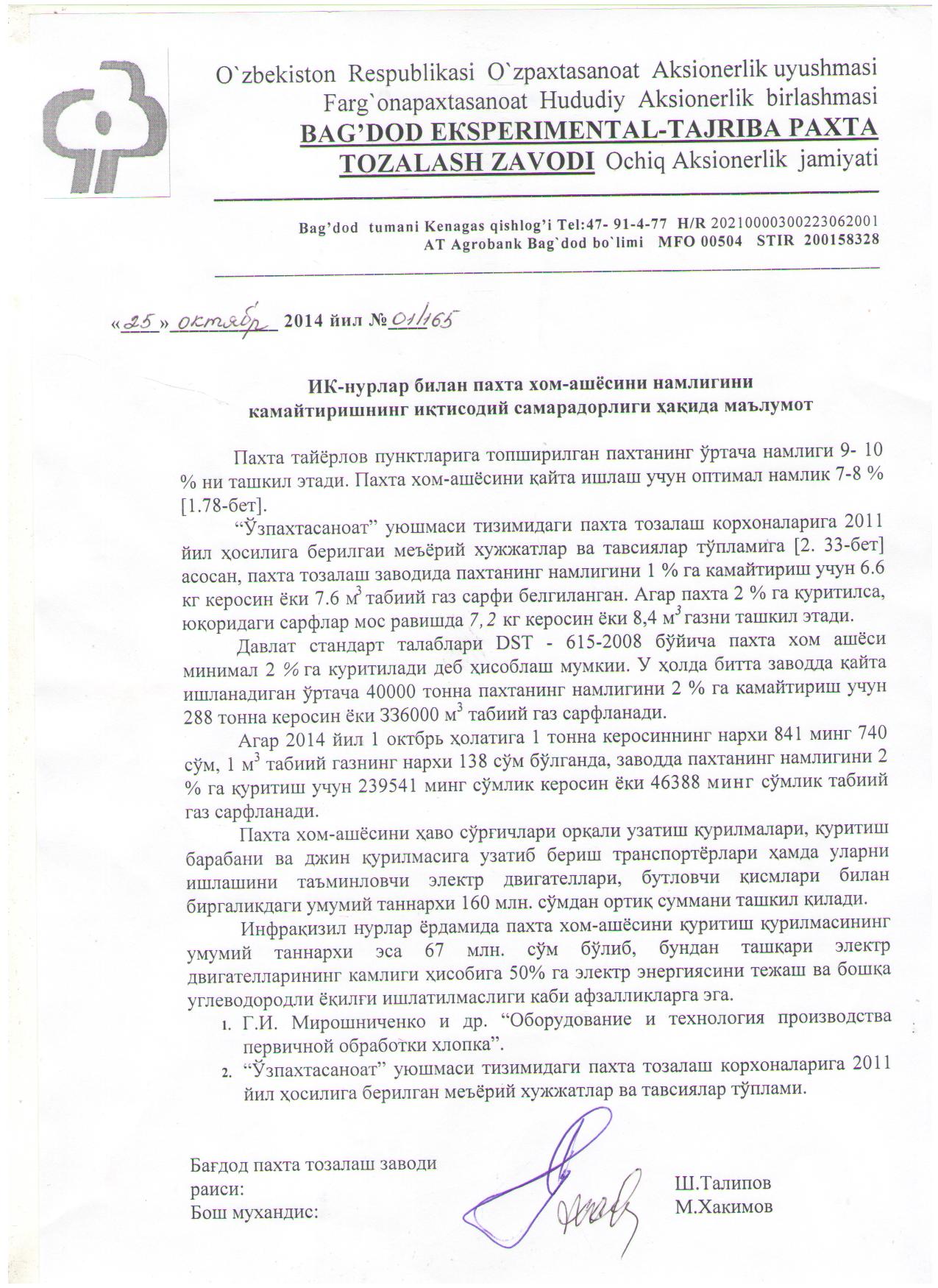
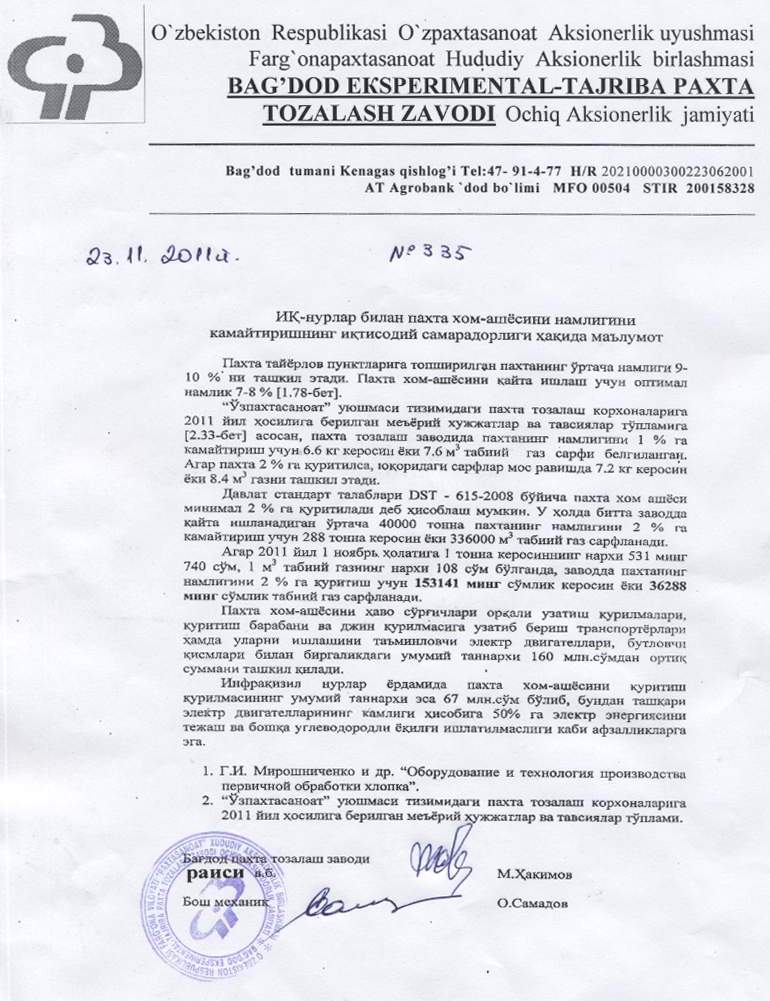
Experimental test calculations demonstrate a clear comparison against the traditional drying method. When reducing moisture content by 1–3%, the total estimated cost in the baseline historical calculation was 1,068.8 UZS for the IR method versus 10,051.5 UZS for traditional drying. This corresponds to an approximate 9.4-fold cost advantage. Electrical energy consumption was reduced from 39.7 kWh to 16.7 kWh — a factor of approximately 2.38.
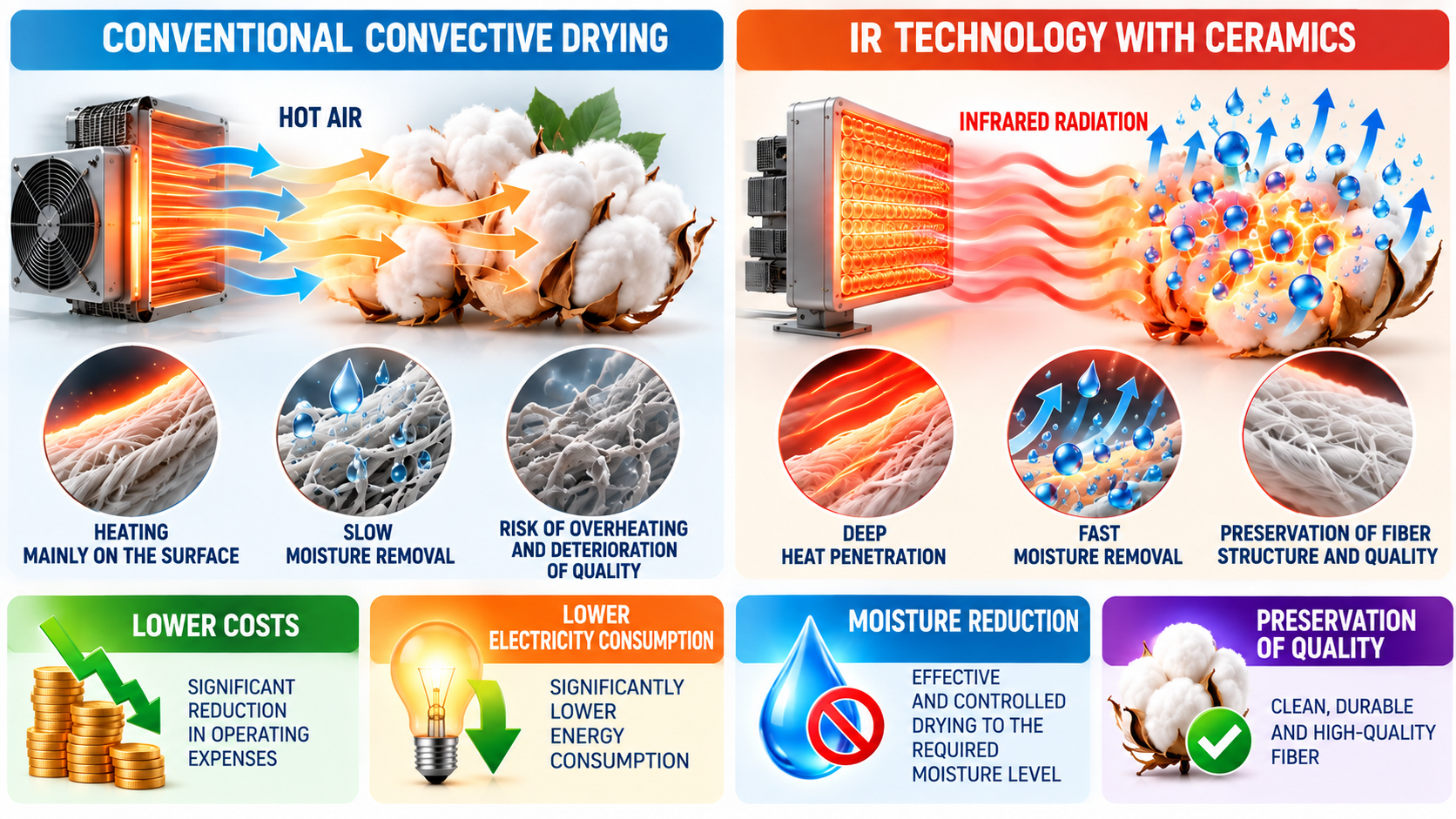
Comparison of physical principle and economic advantages: convective hot-air heating vs pulsed IR radiation with functional ceramics
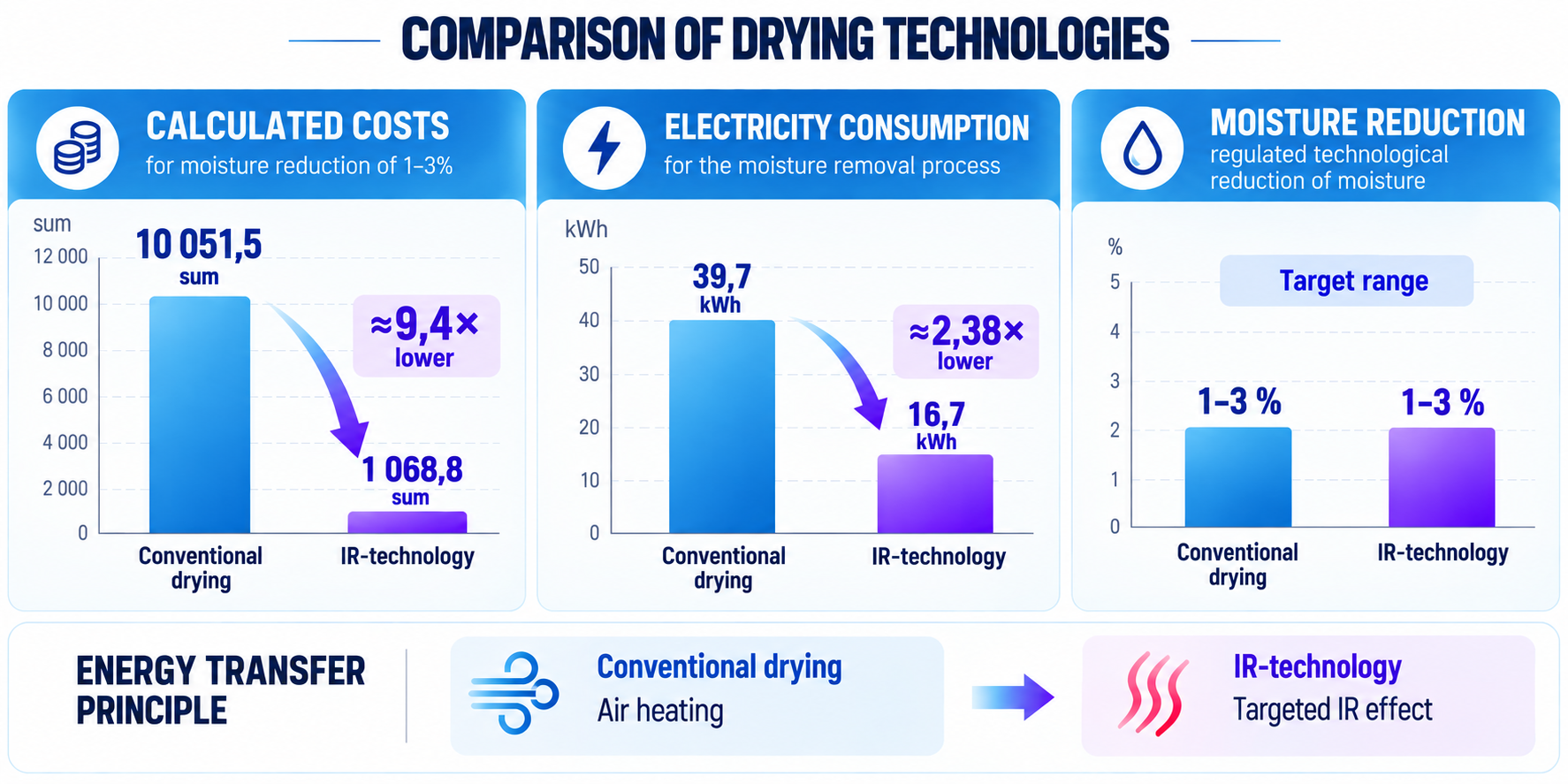
Comparison of drying technologies: calculated operational costs (≈9.4× lower) and power consumption (≈2.38× lower)
Important: calculated values correspond to the baseline parameters and tariffs of the original 2007 calculation and do not represent a contemporary commercial cost estimate. Industrial installations must be calculated based on current tariffs, facility capacity, and required throughput.
Rapid Moisture Reduction
Laboratory trials demonstrated a high rate of moisture removal. For a raw cotton sample with an initial moisture content of 12%, a moisture level of 8.7% was recorded after 2 minutes, and 5.9% after 10 minutes. The primary moisture loss occurred in the first 1–2 minutes, after which the rate of moisture reduction tapered as moisture was extracted from deeper layers.
This makes IR drying particularly advantageous for continuous industrial processes where conveyor throughput speed and precise control of target end moisture are critical.
Not Just Drying: A Unified Technology for Cotton Production
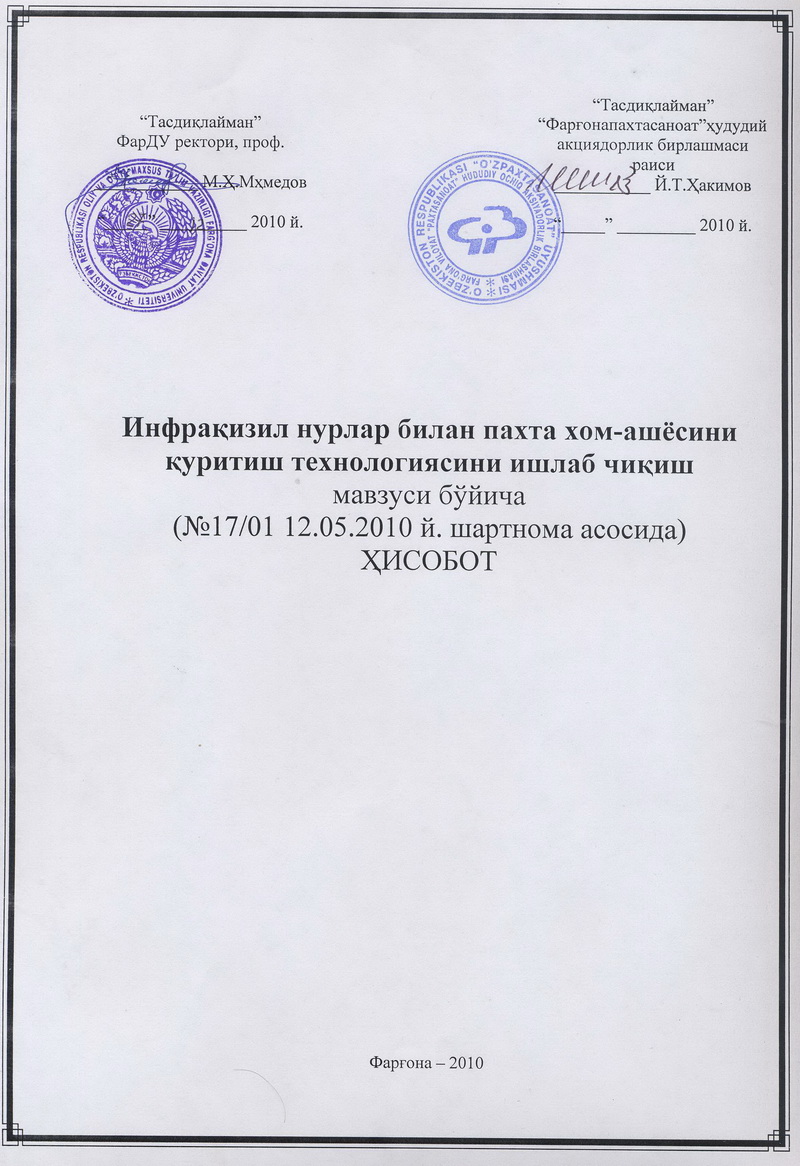
The advantage of the proposed solution lies in its end-to-end integration. A single technological concept encompasses multiple production stages: controlled pre-sowing seed treatment, raw cotton moisture reduction, vapor extraction control, and raw material preparation for ginning or long-term storage.
Seed Treatment Results
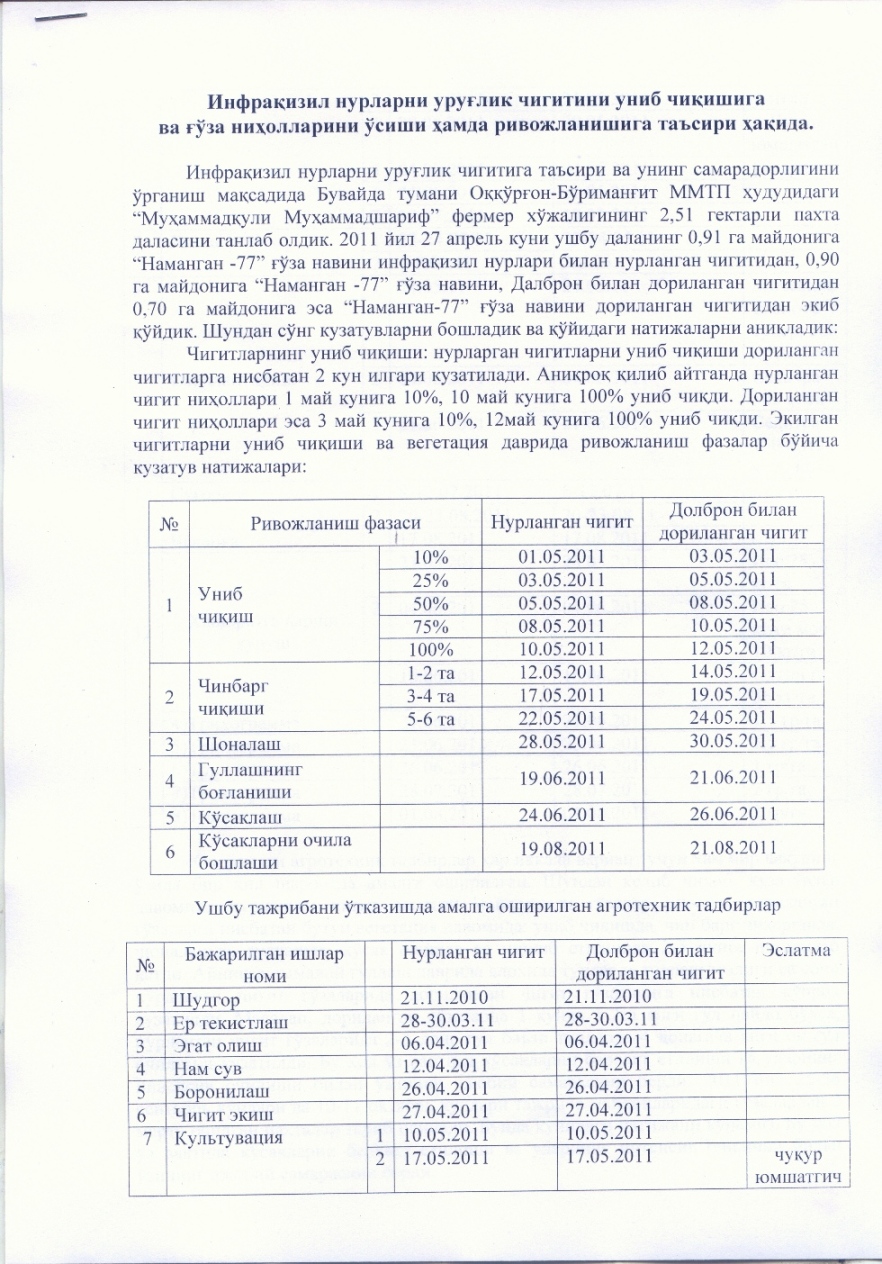
In a 2011 field agronomic trial with the 'Namangan-77' variety, seeds treated with pulsed infrared radiation achieved 100% seedling emergence on May 10 — 2 days earlier than the Dalbron chemical treatment variant and 1 day earlier than the untreated control. Subsequent primary plant development phases also occurred 2–5 days earlier than in the control variants.
Yield on the test plot with IR-treated seeds reached 31.54 c/ha compared to 30.0 c/ha in both comparative control variants. Fiber turnout reached 37.4% versus 36.36% for the Dalbron variant and 36.8% for untreated seeds.
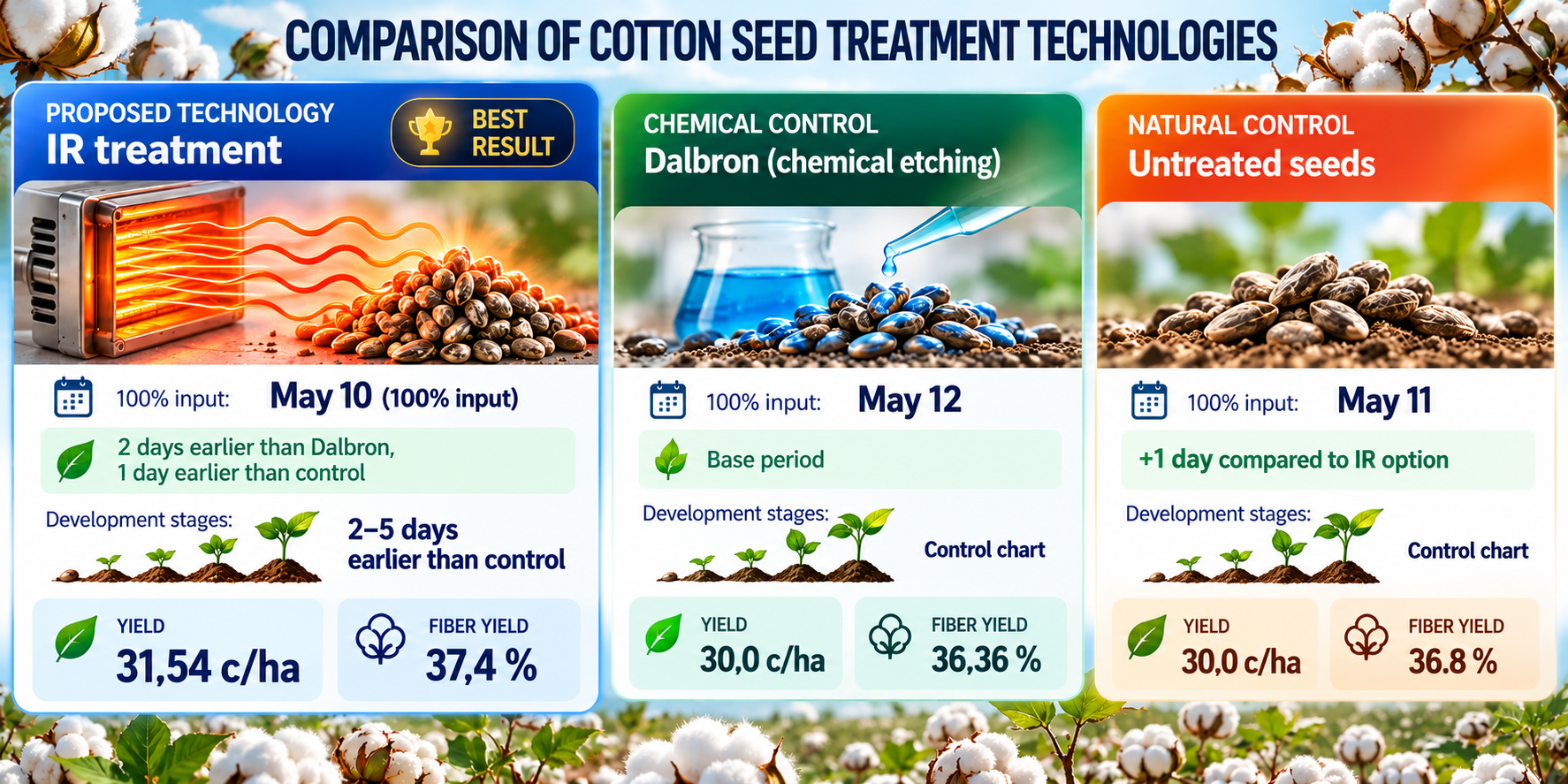
Comparison of cotton seed treatment technologies: field trial (variety «Namangan-77»), germination timing, growth phases, yield (31.54 c/ha), and fiber output (37.4%)
Comparison with Alternative Approaches
To position the technology accurately, it is essential to evaluate conventional hot-air drying alongside modern electromagnetic methods. In agricultural drying applications, microwave technology frequently demonstrates rapid heating and deep volumetric penetration. However, microwave processing carries known technological challenges, including risks of localized uneven heating and product degradation. Therefore, a direct claim of superiority of one method over another requires comprehensive testing specifically on raw cotton under identical industrial conditions.
It is specifically the combination of targeted IR radiation, pulsed regime, and functional ceramics that defines this distinctive technological concept. Unlike simple resistive electric heating, the engineering objective is not bulk overheating of the entire mass, but aligning the emission spectrum with water absorption bands and managing moisture transport dynamics.
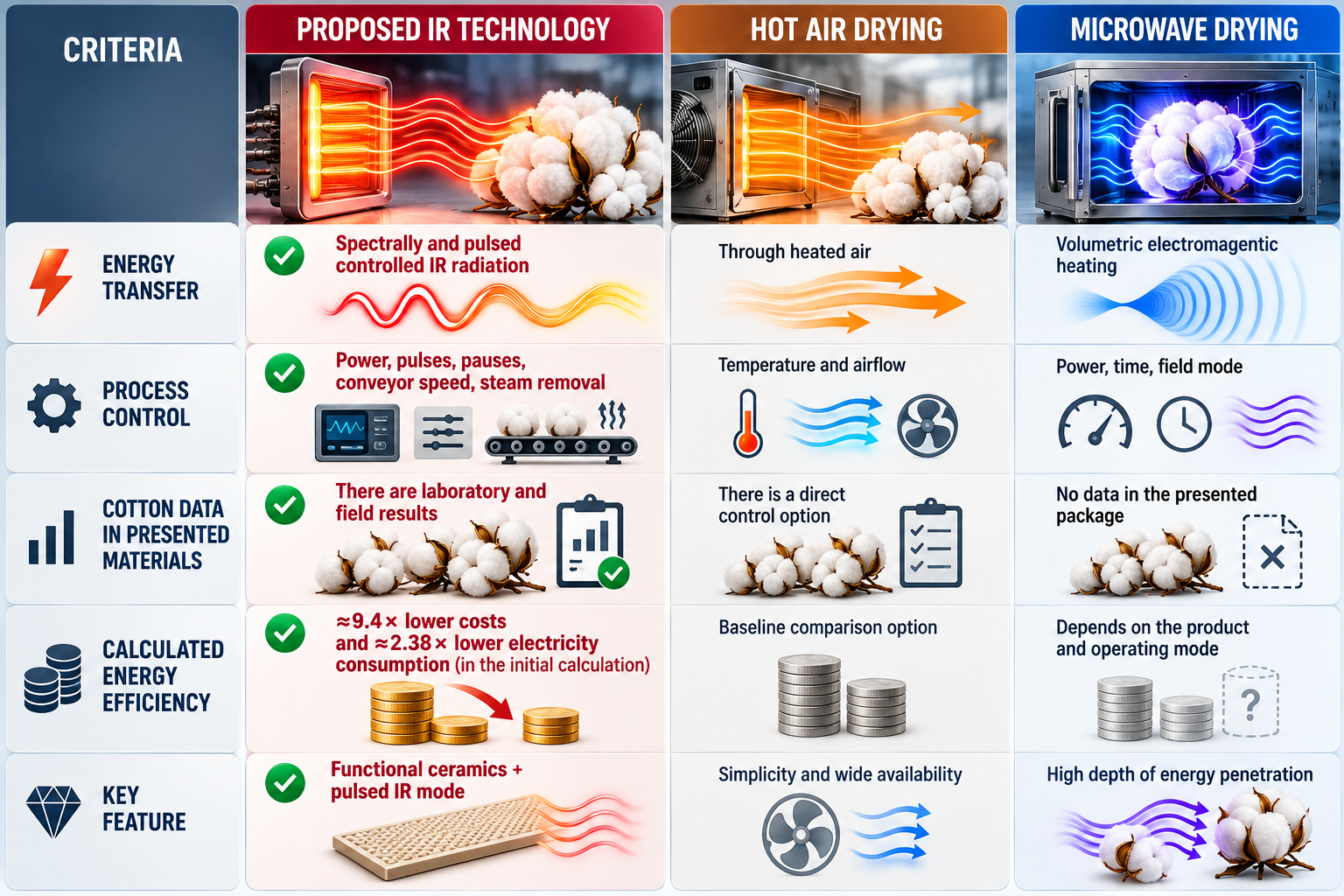
Comparison criteria: proposed IR technology with functional ceramics, convective hot air, and microwave drying
Why Industry Is Interested
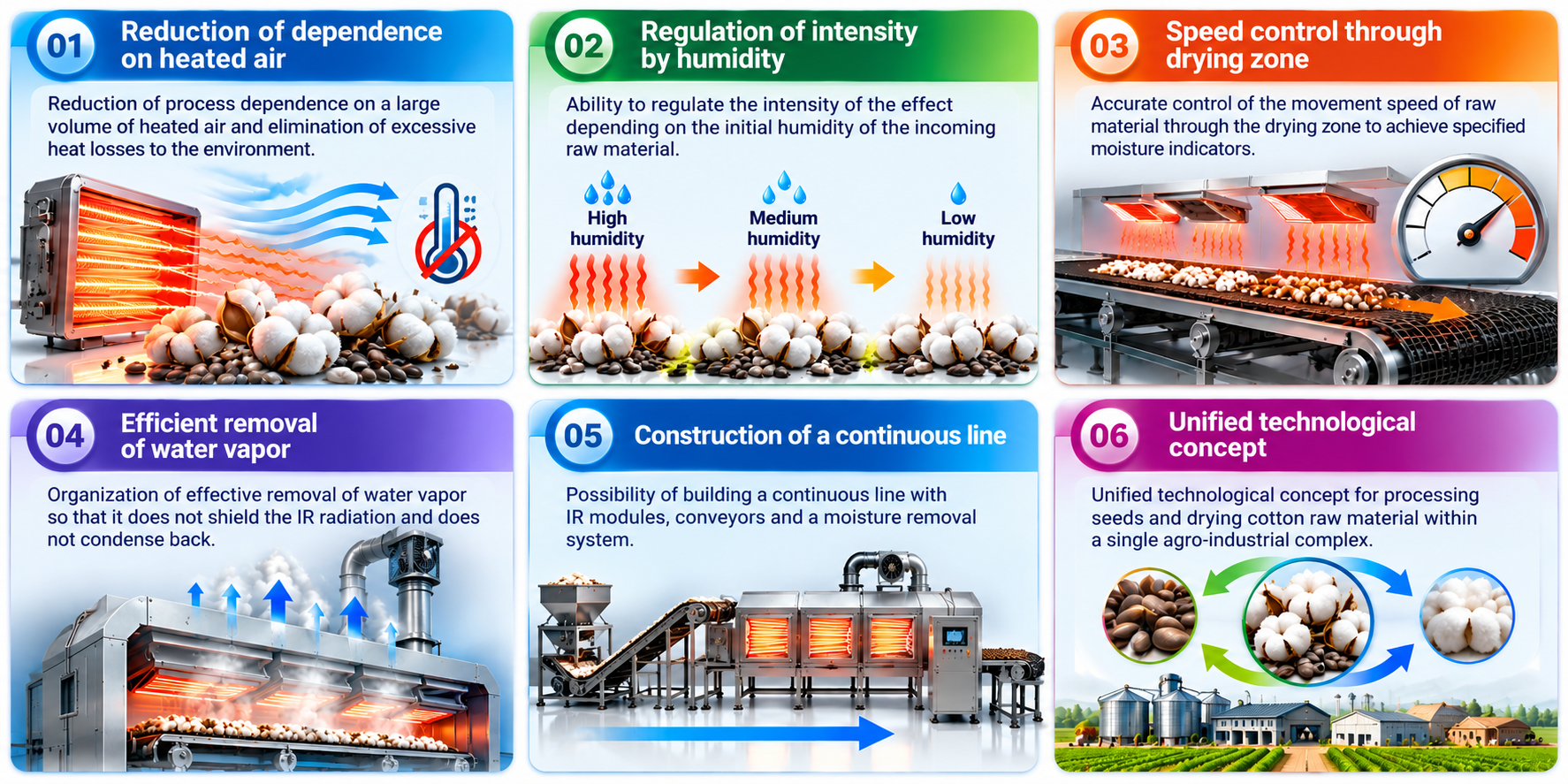
Six technological and economic advantages of the continuous industrial IR drying system
Installation Design and Components
The equipment layout comprises functional ceramic IR emitters, mesh belt conveyors, and air nozzles for evacuating evaporated moisture.
Functional Ceramic IR Emitters
Quartz tubes with nichrome coils and functional ceramic coating tuned for selective spectral emission.
Belt Conveyor
Wire mesh conveyor belt allowing dual-sided infrared penetration and continuous material transport.
Raw Cotton
Even layer of raw cotton moving through the pulsed infrared radiation zone.
Air Nozzles
Strategic air jets breaking boundary vapor layers and carrying moisture away from fiber surfaces.
Steam & Moisture Exhaust
Ducted ventilation hood and exhaust blowers evacuating humid air from the process chamber.
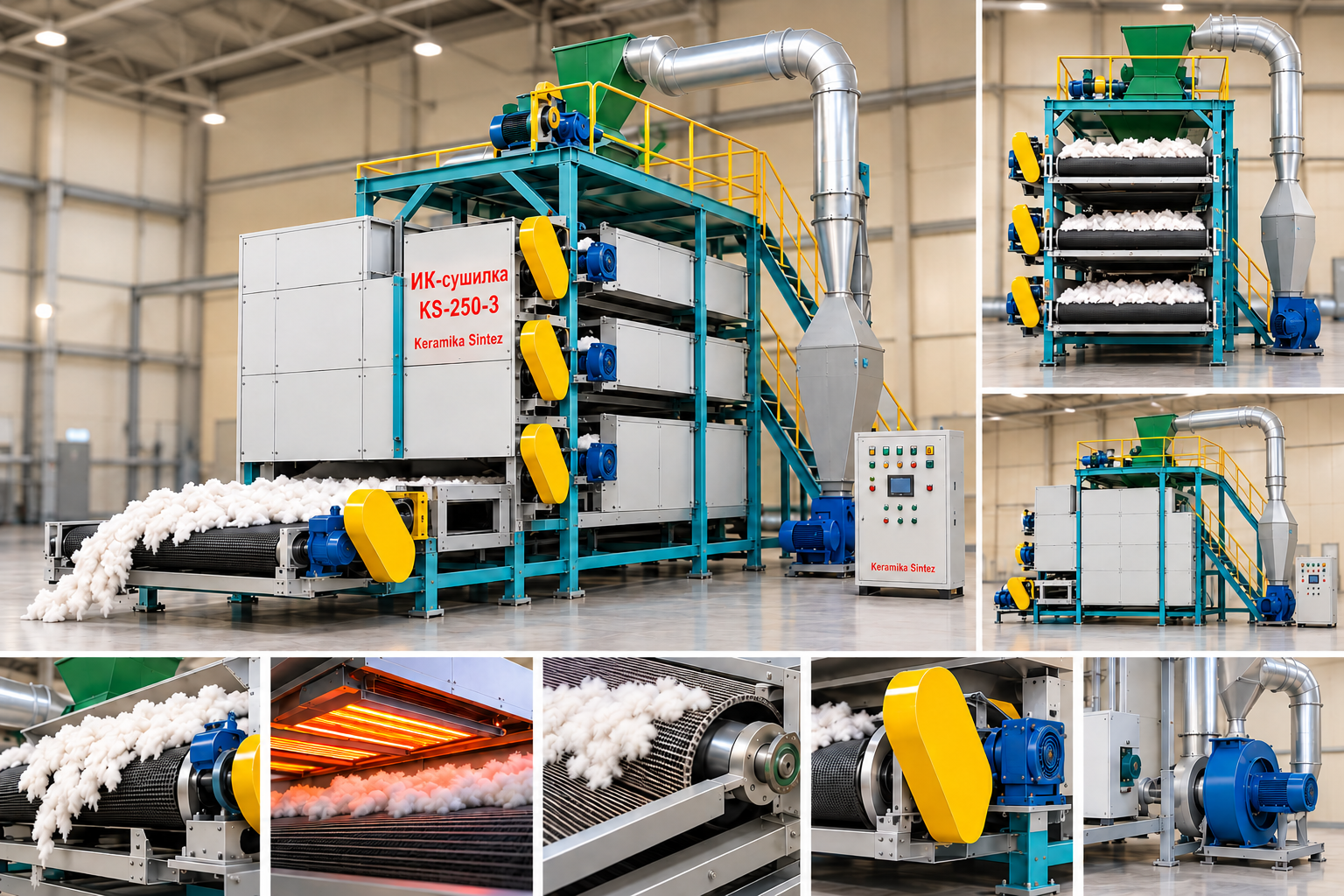
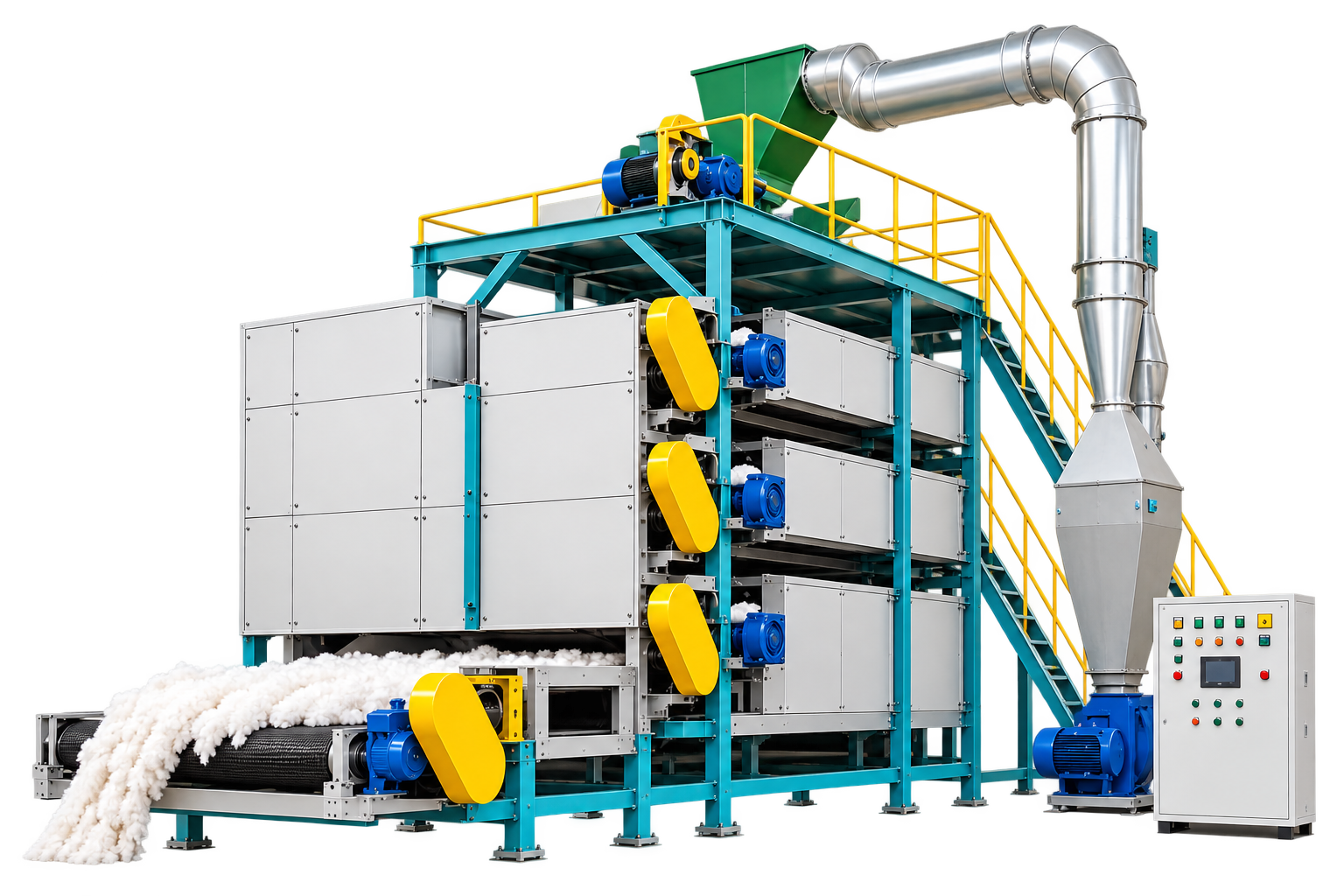
Industrial multi-tier IR cotton dryer KS-250-3: conveyor line, ventilation exhaust and automated control unit
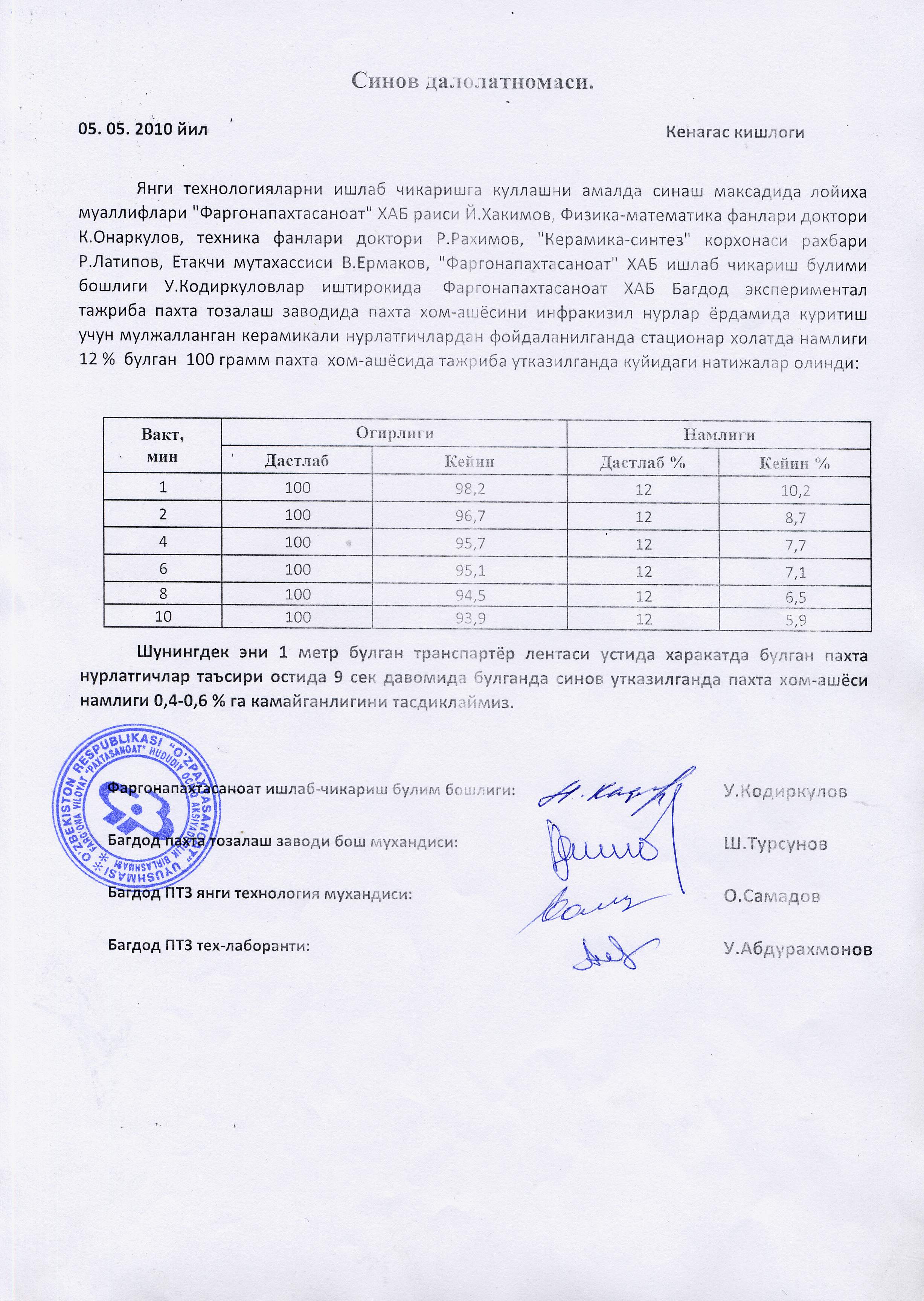
Cotton drying installation test protocol
Cotton drying test report
Cotton drying test report
Raw Cotton Drying Process
Process.avi
Installation Top View
Vidup.avi