





Patient R., male, 35 years old. He has been seropositive for 2 years, diagnosed with AIDS. The patient frequently suffers from abscesses and inflammations of subcutaneous fat, joint pains, and has been hospitalized several times. He came to the hospital complaining of an abscess and inflammation of the subcutaneous fat of the left lower limb, which has been accompanied by high fever for 2 weeks, causing severe joint pain and immobility. Upon examination, the patient's general condition is severe, skin is pale, with a temperature of 39°C that does not decrease despite antibiotics. The skin on the left leg is markedly swollen, especially around the knee, calf, and foot. On the front of the calf, there are two ulcers measuring 3x4 cm, the bottom of which is covered with purulent discharge. The diagnosis is septic arthritis and inflammation of the subcutaneous fat. The patient refused to go to a general hospital. He was given antibiotics for a few days, with the expectation of his return for a follow-up. After discussing with the doctor, he agreed to use IR emitters at home as prescribed. The patient was provided with five IR emitters: GI, ZB, KL, RC, RV, with instructions on how to use them. As soon as home treatment began, the fever normalized (possibly also due to antibiotics). However, the patient did not return for antibiotics but continued treatment only with IR emitters, so this treatment can be considered monotherapy. Treatment was conducted with local emitters. RV-s was applied to all organs (brain, spinal cord, heart, liver, spleen, kidneys, intestines, lungs, tonsils) for 2-3 minutes, 3 times a day. Spinal massage was performed twice a day using the ZB-s emitter. Simultaneously, therapy was aimed at normalizing gut flora, lipid metabolism, and stimulating the adrenal glands twice a day. For the ulcer area, RV-s and GI-s were used for 5-10 minutes with a gradual increase in exposure to 30 minutes, 2-3 times a day.
Results: The patient's general condition improved daily. His well-being improved, no fever was present, and appetite increased. Swelling in the leg and lymphostasis significantly reduced after 2 weeks of treatment, with only slight swelling remaining around the knee. Although signs of septic arthritis were clinically observed, the pain significantly decreased, and the patient could walk with crutches. An ulcer with purulent discharge formed in the popliteal fossa. The patient continues treatment with local emitters at home, showing signs of improvement. No side effects were observed.
Comments: We were concerned that the patient might experience worsening of a cold, as the ZB emitter dilates blood vessels, and with blood flow, there could be an increased spread of breakdown products and infectious agents throughout the body. If the general condition worsens, the patient is advised to reduce the exposure time of the ZB emitter, which could hinder optimal treatment. Fortunately, the patient experienced no complications, and the cold subsided immediately after the first day of therapy.
Clinical observation materials:
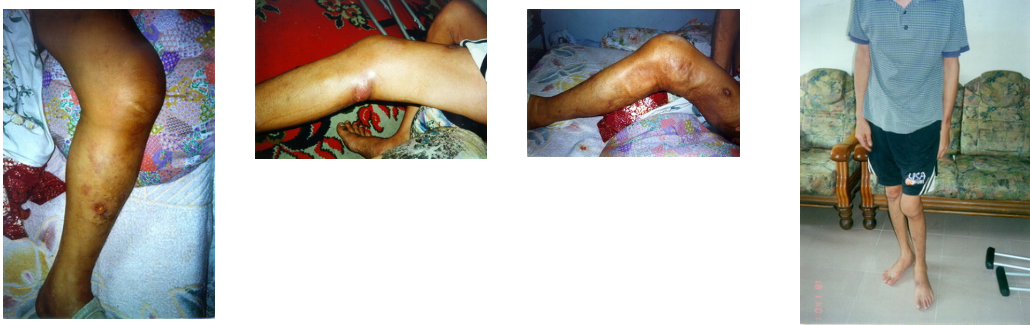
Clinical case: Inflammation of subcutaneous adipose tissue in AIDS